
AutoML Papers
Source: https://github.com/hibayesian/awesome-automl-papers at
0317821496b4
License: Apache-2.0
Read the English original
This edition is an AI-assisted translation.
Awesome-AutoML-Papers
Abschnitt betitelt „Awesome-AutoML-Papers“Awesome-AutoML-Papers ist eine kuratierte Sammlung von Forschungsarbeiten, Artikeln, Tutorials, Folien und Projekten zum automatisierten maschinellen Lernen. Gib diesem Repository einen Stern, um über die neuesten Entwicklungen dieses rasant wachsenden Forschungsgebiets auf dem Laufenden zu bleiben. Vielen Dank an alle, die zu diesem Projekt beigetragen haben. Mach mit und trage gern selbst etwas bei.

Was ist AutoML?
Abschnitt betitelt „Was ist AutoML?“Automatisiertes maschinelles Lernen (AutoML) bietet Methoden und Prozesse, mit denen auch Personen ohne ML-Expertise maschinelles Lernen einsetzen, dessen Effizienz steigern und die ML-Forschung beschleunigen können.
Maschinelles Lernen (ML) hat in den vergangenen Jahren beträchtliche Erfolge erzielt, und immer mehr Fachgebiete stützen sich darauf. Diese Erfolge hängen jedoch entscheidend davon ab, dass ML-Fachleute folgende Aufgaben übernehmen:
- Daten vorverarbeiten,
- Geeignete Merkmale auswählen,
- Eine geeignete Modellfamilie auswählen,
- Modellhyperparameter optimieren,
- Modelle des maschinellen Lernens nachbearbeiten,
- Die erzielten Ergebnisse kritisch analysieren,
Da diese Aufgaben für Nichtfachleute oft zu komplex sind, hat das rasante Wachstum von ML-Anwendungen eine Nachfrage nach sofort einsetzbaren Methoden geschaffen, die sich ohne Expertenwissen leicht anwenden lassen. Das Forschungsgebiet, das auf eine schrittweise Automatisierung des maschinellen Lernens abzielt, nennen wir AutoML. Als neues Teilgebiet des ML erhält AutoML nicht nur dort, sondern auch in Computer Vision, natürlicher Sprachverarbeitung und Graphenverarbeitung zunehmend Aufmerksamkeit.
Eine formale Definition von AutoML gibt es nicht. Den Beschreibungen der meisten Arbeiten zufolge lässt sich der grundlegende Ablauf von AutoML wie folgt darstellen.
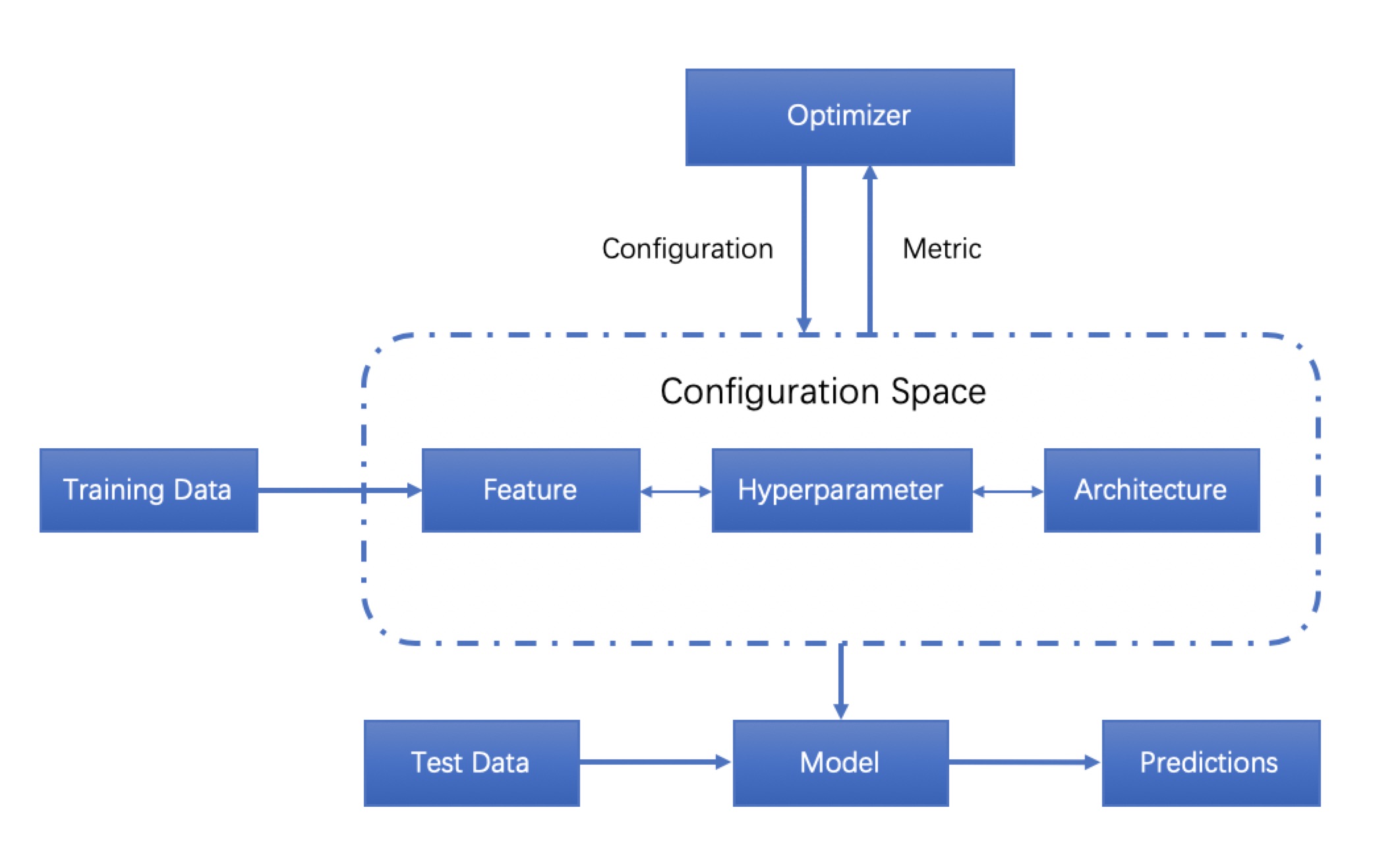
AutoML-Ansätze sind inzwischen ausgereift genug, um mit ML-Fachleuten mitzuhalten und sie manchmal sogar zu übertreffen. Einfach gesagt kann AutoML die Leistung verbessern und zugleich viel Zeit und Geld sparen, denn ML-Fachleute sind schwer zu finden und teuer. Daher ist das kommerzielle Interesse an AutoML in den vergangenen Jahren stark gestiegen; mehrere große Technologieunternehmen und Start-ups entwickeln inzwischen eigene AutoML-Systeme. Die folgende Tabelle vergleicht einige davon im Überblick.
| Unternehmen | AutoFE | HPO | NAS |
|---|---|---|---|
| 4paradigm | √ | √ | × |
| Alibaba | × | √ | × |
| Baidu | × | × | √ |
| Determined AI | × | √ | √ |
| √ | √ | √ | |
| DataCanvas | √ | √ | √ |
| H2O.ai | √ | √ | × |
| Microsoft | × | √ | √ |
| MLJAR | √ | √ | √ |
| RapidMiner | √ | √ | × |
| Tencent | × | √ | × |
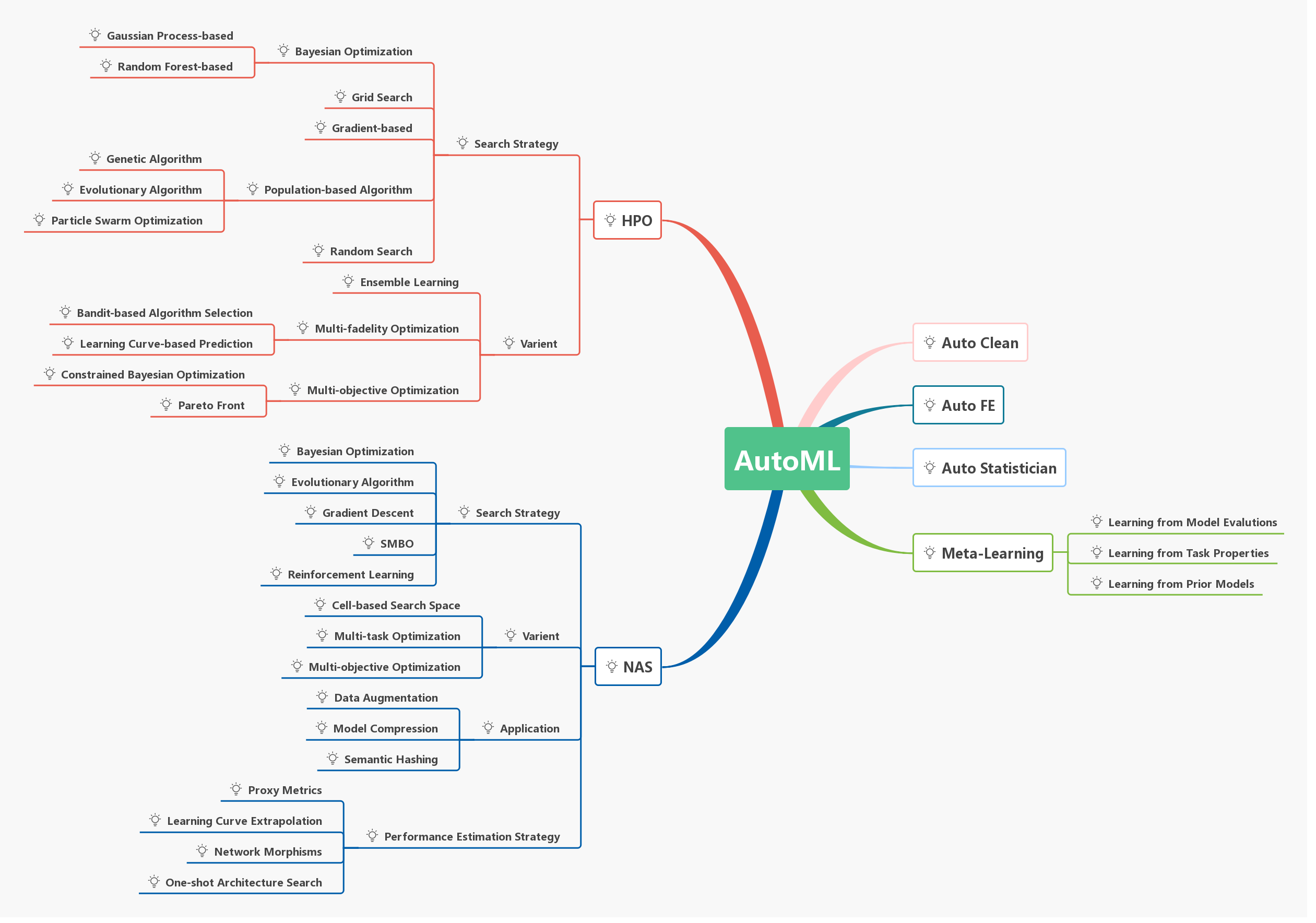
Awesome-AutoML-Papers bietet aktuelle Übersichten zu den grundlegenden Techniken des AutoML:
- Automatisierte Datenbereinigung (Auto Clean)
- Automatisierte Feature-Entwicklung (Auto FE)
- Hyperparameteroptimierung (HPO)
- Meta-Learning
- Suche nach neuronalen Architekturen (NAS)
Inhaltsverzeichnis
Abschnitt betitelt „Inhaltsverzeichnis“- Forschungsarbeiten
- Tutorials
- Artikel
- Folien
- Bücher
- Projekte
- Prominente Forschende
Forschungsarbeiten
Abschnitt betitelt „Forschungsarbeiten“Übersichtsarbeiten
Abschnitt betitelt „Übersichtsarbeiten“- 2019 | AutoML: A Survey of the State-of-the-Art | Xin He, et al. | arXiv |
PDF - 2019 | Survey on Automated Machine Learning | Marc Zoeller, Marco F. Huber | arXiv |
PDF - 2019 | Automated Machine Learning: State-of-The-Art and Open Challenges | Radwa Elshawi, et al. | arXiv |
PDF - 2018 | Taking Human out of Learning Applications: A Survey on Automated Machine Learning | Quanming Yao, et al. | arXiv |
PDF - 2020 | On Hyperparameter Optimization of Machine Learning Algorithms: Theory and Practice | Li Yang, et al. | Neurocomputing |
PDF - 2020 | Automated Machine Learning—a brief review at the end of the early years | Escalante, H. J. | arXiv |
PDF - 2022 | IoT Data Analytics in Dynamic Environments: From An Automated Machine Learning Perspective | Li Yang, et al. | arXiv |
PDF - 2024 | Automated machine learning: past, present and future | Baratchi. M, et al. | Artificial Intelligence Review |
Springer
Automatisierte Feature-Entwicklung
Abschnitt betitelt „Automatisierte Feature-Entwicklung“-
Erweitern und Reduzieren
Abschnitt betitelt „Erweitern und Reduzieren“
- 2022 | BERT-Sort: A Zero-shot MLM Semantic Encoder on Ordinal Features for AutoML | Mehdi Bahrami, et al. | AutoML |
PDF - 2017 | AutoLearn — Automated Feature Generation and Selection | Ambika Kaul, et al. | ICDM |
PDF - 2017 | One button machine for automating feature engineering in relational databases | Hoang Thanh Lam, et al. | arXiv |
PDF - 2016 | Automating Feature Engineering | Udayan Khurana, et al. | NIPS |
PDF - 2016 | ExploreKit: Automatic Feature Generation and Selection | Gilad Katz, et al. | ICDM |
PDF - 2015 | Deep Feature Synthesis: Towards Automating Data Science Endeavors | James Max Kanter, Kalyan Veeramachaneni | DSAA |
PDF
-
Hierarchische Anordnung von Transformationen
Abschnitt betitelt „Hierarchische Anordnung von Transformationen“- 2016 | Cognito: Automated Feature Engineering for Supervised Learning | Udayan Khurana, et al. | ICDMW |
PDF
- 2016 | Cognito: Automated Feature Engineering for Supervised Learning | Udayan Khurana, et al. | ICDMW |
-
Meta-Learning
Abschnitt betitelt „Meta-Learning“ -
Reinforcement Learning
Abschnitt betitelt „Reinforcement Learning“
Architektursuche
Abschnitt betitelt „Architektursuche“-
Evolutionäre Algorithmen
Abschnitt betitelt „Evolutionäre Algorithmen“- 2019 | Evolutionary Neural AutoML for Deep Learning | Jason Liang, et al. | GECCO |
PDF - 2017 | Large-Scale Evolution of Image Classifiers | Esteban Real, et al. | PMLR |
PDF - 2002 | Evolving Neural Networks through Augmenting Topologies | Kenneth O.Stanley, Risto Miikkulainen | Evolutionary Computation |
PDF
- 2019 | Evolutionary Neural AutoML for Deep Learning | Jason Liang, et al. | GECCO |
-
Lokale Suche
Abschnitt betitelt „Lokale Suche“- 2017 | Simple and Efficient Architecture Search for Convolutional Neural Networks | Thomoas Elsken, et al. | ICLR |
PDF
- 2017 | Simple and Efficient Architecture Search for Convolutional Neural Networks | Thomoas Elsken, et al. | ICLR |
-
Meta-Learning
Abschnitt betitelt „Meta-Learning“- 2016 | Learning to Optimize | Ke Li, Jitendra Malik | arXiv |
PDF
- 2016 | Learning to Optimize | Ke Li, Jitendra Malik | arXiv |
-
Reinforcement Learning
Abschnitt betitelt „Reinforcement Learning“- 2018 | AMC: AutoML for Model Compression and Acceleration on Mobile Devices | Yihui He, et al. | ECCV |
PDF - 2018 | Efficient Neural Architecture Search via Parameter Sharing | Hieu Pham, et al. | arXiv |
PDF - 2017 | Neural Architecture Search with Reinforcement Learning | Barret Zoph, Quoc V. Le | ICLR |
PDF
- 2018 | AMC: AutoML for Model Compression and Acceleration on Mobile Devices | Yihui He, et al. | ECCV |
-
Transferlernen
Abschnitt betitelt „Transferlernen“- 2017 | Learning Transferable Architectures for Scalable Image Recognition | Barret Zoph, et al. | arXiv |
PDF
- 2017 | Learning Transferable Architectures for Scalable Image Recognition | Barret Zoph, et al. | arXiv |
-
Netzwerk-Morphing
Abschnitt betitelt „Netzwerk-Morphing“- 2019 | Auto-Keras: An Efficient Neural Architecture Search System | Haifeng Jin, et al. | KDD |
PDF
- 2019 | Auto-Keras: An Efficient Neural Architecture Search System | Haifeng Jin, et al. | KDD |
-
Kontinuierliche Optimierung
Abschnitt betitelt „Kontinuierliche Optimierung“
Software-Frameworks
Abschnitt betitelt „Software-Frameworks“- 2019 | Auptimizer — an Extensible, Open-Source Framework for Hyperparameter Tuning | Jiayi Liu, et al. | IEEE Big Data |
PDF - 2019 | Towards modular and programmable architecture search | Renato Negrinho, et al. | NeurIPS |
PDF - 2019 | Evolutionary Neural AutoML for Deep Learning | Jason Liang, et al. | arXiv |
PDF - 2017 | ATM: A Distributed, Collaborative, Scalable System for Automated Machine Learning | T. Swearingen, et al. | IEEE |
PDF - 2017 | Google Vizier: A Service for Black-Box Optimization | Daniel Golovin, et al. | KDD |
PDF - 2015 | AutoCompete: A Framework for Machine Learning Competitions | Abhishek Thakur, et al. | ICML |
PDF
Hyperparameteroptimierung
Abschnitt betitelt „Hyperparameteroptimierung“-
Bayessche Optimierung
Abschnitt betitelt „Bayessche Optimierung“- 2020 | Bayesian Optimization of Risk Measures | NeurIPS |
PDF - 2020 | BOTORCH: A Framework for Efficient Monte-Carlo Bayesian Optimization | NeurIPS |
PDF - 2020 | Tuning Hyperparameters without Grad Students: Scalable and Robust Bayesian Optimisation with Dragonfly | JMLR |
PDF - 2019 | Bayesian Optimization with Unknown Search Space | NeurIPS |
PDF - 2019 | Constrained Bayesian optimization with noisy experiments |
PDF - 2019 | Learning search spaces for Bayesian optimization: Another view of hyperparameter transfer learning | NeurIPS |
PDF - 2019 | Practical Two-Step Lookahead Bayesian Optimization | NeurIPS |
PDF - 2019 | Predictive entropy search for multi-objective bayesian optimization with constraints |
PDF - 2018 | BOCK: Bayesian optimization with cylindrical kernels | ICML |
PDF - 2018 | Efficient High Dimensional Bayesian Optimization with Additivity and Quadrature Fourier Features | Mojmír Mutný, et al. | NeurIPS |
PDF - 2018 | High-Dimensional Bayesian Optimization via Additive Models with Overlapping Groups. | PMLR |
PDF - 2018 | Maximizing acquisition functions for Bayesian optimization | NeurIPS |
PDF - 2018 | Scalable hyperparameter transfer learning | NeurIPS |
PDF - 2016 | Bayesian Optimization with Robust Bayesian Neural Networks | Jost Tobias Springenberg, et al. | NIPS |
PDF - 2016 | Scalable Hyperparameter Optimization with Products of Gaussian Process Experts | Nicolas Schilling, et al. | PKDD |
PDF - 2016 | Taking the Human Out of the Loop: A Review of Bayesian Optimization | Bobak Shahriari, et al. | IEEE |
PDF - 2016 | Towards Automatically-Tuned Neural Networks | Hector Mendoza, et al. | JMLR |
PDF - 2016 | Two-Stage Transfer Surrogate Model for Automatic Hyperparameter Optimization | Martin Wistuba, et al. | PKDD |
PDF - 2015 | Efficient and Robust Automated Machine Learning |
PDF - 2015 | Hyperparameter Optimization with Factorized Multilayer Perceptrons | Nicolas Schilling, et al. | PKDD |
PDF - 2015 | Hyperparameter Search Space Pruning - A New Component for Sequential Model-Based Hyperparameter Optimization | Martin Wistua, et al. |
PDF - 2015 | Joint Model Choice and Hyperparameter Optimization with Factorized Multilayer Perceptrons | Nicolas Schilling, et al. | ICTAI |
PDF - 2015 | Learning Hyperparameter Optimization Initializations | Martin Wistuba, et al. | DSAA |
PDF - 2015 | Scalable Bayesian optimization using deep neural networks | Jasper Snoek, et al. | ACM |
PDF - 2015 | Sequential Model-free Hyperparameter Tuning | Martin Wistuba, et al. | ICDM |
PDF - 2013 | Auto-WEKA: Combined Selection and Hyperparameter Optimization of Classification Algorithms |
PDF - 2013 | Making a Science of Model Search: Hyperparameter Optimization in Hundreds of Dimensions for Vision Architectures | J. Bergstra | JMLR |
PDF - 2012 | Practical Bayesian Optimization of Machine Learning Algorithms |
PDF - 2011 | Sequential Model-Based Optimization for General Algorithm Configuration(extended version) |
PDF
- 2020 | Bayesian Optimization of Risk Measures | NeurIPS |
-
Evolutionäre Algorithmen
Abschnitt betitelt „Evolutionäre Algorithmen“- 2020 | Delta-STN: Efficient Bilevel Optimization for Neural Networks using Structured Response Jacobians | Juhan Bae, Roger Grosse | Neurips |
PDF - 2018 | Autostacker: A Compositional Evolutionary Learning System | Boyuan Chen, et al. | arXiv |
PDF - 2017 | Large-Scale Evolution of Image Classifiers | Esteban Real, et al. | PMLR |
PDF - 2016 | Automating biomedical data science through tree-based pipeline optimization | Randal S. Olson, et al. | ECAL |
PDF - 2016 | Evaluation of a tree-based pipeline optimization tool for automating data science | Randal S. Olson, et al. | GECCO |
PDF
- 2020 | Delta-STN: Efficient Bilevel Optimization for Neural Networks using Structured Response Jacobians | Juhan Bae, Roger Grosse | Neurips |
-
Lipschitz Functions
Abschnitt betitelt „Lipschitz Functions“- 2017 | Global Optimization of Lipschitz functions | C´edric Malherbe, Nicolas Vayatis | arXiv |
PDF
- 2017 | Global Optimization of Lipschitz functions | C´edric Malherbe, Nicolas Vayatis | arXiv |
-
Lokale Suche
Abschnitt betitelt „Lokale Suche“- 2009 | ParamILS: An Automatic Algorithm Configuration Framework | Frank Hutter, et al. | JAIR |
PDF
- 2009 | ParamILS: An Automatic Algorithm Configuration Framework | Frank Hutter, et al. | JAIR |
-
Meta-Learning
Abschnitt betitelt „Meta-Learning“- 2019 | OBOE: Collaborative Filtering for AutoML Model Selection | Chengrun Yang, et al. | KDD |
PDF - 2019 | SMARTML: A Meta Learning-Based Framework for Automated Selection and Hyperparameter Tuning for Machine Learning Algorithms |
PDF - 2008 | Cross-Disciplinary Perspectives on Meta-Learning for Algorithm Selection |
PDF
- 2019 | OBOE: Collaborative Filtering for AutoML Model Selection | Chengrun Yang, et al. | KDD |
-
Partikelschwarmoptimierung
Abschnitt betitelt „Partikelschwarmoptimierung“- 2017 | Particle Swarm Optimization for Hyper-parameter Selection in Deep Neural Networks | Pablo Ribalta Lorenzo, et al. | GECCO |
PDF - 2008 | Particle Swarm Optimization for Parameter Determination and Feature Selection of Support Vector Machines | Shih-Wei Lin, et al. | Expert Systems with Applications |
PDF
- 2017 | Particle Swarm Optimization for Hyper-parameter Selection in Deep Neural Networks | Pablo Ribalta Lorenzo, et al. | GECCO |
-
Zufallssuche
Abschnitt betitelt „Zufallssuche“ -
Transferlernen
Abschnitt betitelt „Transferlernen“- 2016 | Efficient Transfer Learning Method for Automatic Hyperparameter Tuning | Dani Yogatama, Gideon Mann | JMLR |
PDF - 2016 | Flexible Transfer Learning Framework for Bayesian Optimisation | Tinu Theckel Joy, et al. | PAKDD |
PDF - 2016 | Hyperparameter Optimization Machines | Martin Wistuba, et al. | DSAA |
PDF - 2013 | Collaborative Hyperparameter Tuning | R´emi Bardenet, et al. | ICML |
PDF
- 2016 | Efficient Transfer Learning Method for Automatic Hyperparameter Tuning | Dani Yogatama, Gideon Mann | JMLR |
Sonstiges
Abschnitt betitelt „Sonstiges“- 2020 | Automated Machine Learning Techniques for Data Streams | Alexandru-Ionut Imbrea |
PDF - 2018 | Accelerating Neural Architecture Search using Performance Prediction | Bowen Baker, et al. | ICLR |
PDF - 2017 | Automatic Frankensteining: Creating Complex Ensembles Autonomously | Martin Wistuba, et al. | SIAM |
PDF - 2018 | Characterizing classification datasets: A study of meta-features for meta-learning | Rivolli, Adriano, et al. | arXiv |
PDF - 2020 | Putting the Human Back in the AutoML Loop | Xanthopoulos, Iordanis, et al. | EDBT/ICDT |
PDF
Tutorials
Abschnitt betitelt „Tutorials“Bayessche Optimierung
Abschnitt betitelt „Bayessche Optimierung“- 2018 | A Tutorial on Bayesian Optimization. |
PDF - 2010 | A Tutorial on Bayesian Optimization of Expensive Cost Functions, with Application to Active User Modeling and Hierarchical Reinforcement Learning |
PDF
Meta-Learning
Abschnitt betitelt „Meta-Learning“- 2008 | Metalearning - A Tutorial |
PDF
| Typ | Blogtitel | Link |
|---|---|---|
| HPO | Bayesian Optimization for Hyperparameter Tuning | Link |
| Meta-Learning | Learning to learn | Link |
| Meta-Learning | Why Meta-learning is Crucial for Further Advances of Artificial Intelligence? | Link |
| Erscheinungsjahr | Typ | Buchtitel | Autoren | Verlag | Link |
|---|---|---|---|---|---|
| 2009 | Meta-Learning | Metalearning - Applications to Data Mining | Brazdil, P., Giraud Carrier, C., Soares, C., Vilalta, R. | Springer | Download |
| 2019 | HPO, Meta-Learning, NAS | AutoML: Methods, Systems, Challenges | Frank Hutter, Lars Kotthoff, Joaquin Vanschoren | Download | |
| 2021 | Learning | Automated Machine Learning in Action | Qinquan Song, Haifeng Jin, Xia Hu | Manning Publications | Download |
| Titel | Autor | Link | | AutoML Basics: Automated Machine Learning in Action | Qinquan Song, Haifeng Jin, Xia Hu | (https://www.youtube.com/watch?v=9KpieG0B7VM) |
Projekte
Abschnitt betitelt „Projekte“| Projekt | Typ | Sprache | Lizenz | Link |
|---|---|---|---|---|
| AdaNet | NAS | Python | Apache-2.0 | Github |
| Advisor | HPO | Python | Apache-2.0 | Github |
| AMLA | HPO, NAS | Python | Apache-2.0 | Github |
| ATM | HPO | Python | MIT | Github |
| Auger | HPO | Python | Commercial | Homepage |
| auptimizer | HPO, NAS | Python (support R script) | GPL-3.0 | Github |
| Auto-Keras | NAS | Python | License | Github |
| AutoML Vision | NAS | Python | Commercial | Homepage |
| AutoML Video Intelligence | NAS | Python | Commercial | Homepage |
| AutoML Natural Language | NAS | Python | Commercial | Homepage |
| AutoML Translation | NAS | Python | Commercial | Homepage |
| AutoML Tables | AutoFE, HPO | Python | Commercial | Homepage |
| AutoPyTorch | HPO, NAS | Python | Apache-2.0 | Github |
| HyperGBM | HPO | Python | Python | Github |
| HyperKeras | NAS | Python | Python | Github |
| Hypernets | HPO, NAS | Python | Python | Github |
| auto-sklearn | HPO | Python | License | Github |
| auto_ml | HPO | Python | MIT | Github |
| BayesianOptimization | HPO | Python | MIT | Github |
| BayesOpt | HPO | C++ | AGPL-3.0 | Github |
| comet | HPO | Python | Commercial | Homepage |
| DataRobot | HPO | Python | Commercial | Homepage |
| DEvol | NAS | Python | MIT | Github |
| DeepArchitect | NAS | Python | MIT | Github |
| Determined | HPO, NAS | Python | Apache-2.0 | Github |
| Driverless AI | AutoFE | Python | Commercial | Homepage |
| FAR-HO | HPO | Python | MIT | Github |
| H2O AutoML | HPO | Python, R, Java, Scala | Apache-2.0 | Github |
| HpBandSter | HPO | Python | BSD-3-Clause | Github |
| HyperBand | HPO | Python | License | Github |
| Hyperopt | HPO | Python | License | Github |
| Hyperopt-sklearn | HPO | Python | License | Github |
| Hyperparameter Hunter | HPO | Python | MIT | Github |
| Katib | HPO | Python | Apache-2.0 | Github |
| MateLabs | HPO | Python | Commercial | Github |
| Milano | HPO | Python | Apache-2.0 | Github |
| MLJAR | AutoFE, HPO, NAS | Python | MIT | Github |
| mlr3automl | HPO | R | LGPL-3.0 | GitHub |
| nasbot | NAS | Python | MIT | Github |
| neptune | HPO | Python | Commercial | Homepage |
| NNI | HPO, NAS | Python | MIT | Github |
| Oboe | HPO | Python | BSD-3-Clause | Github |
| Optunity | HPO | Python | License | Github |
| R2.ai | HPO | Commercial | Homepage | |
| RBFOpt | HPO | Python | License | Github |
| RoBO | HPO | Python | BSD-3-Clause | Github |
| Scikit-Optimize | HPO | Python | License | Github |
| SigOpt | HPO | Python | Commercial | Homepage |
| SMAC3 | HPO | Python | License | Github |
| TPOT | AutoFE, HPO | Python | LGPL-3.0 | Github |
| TransmogrifAI | HPO | Scala | BSD-3-Clause | Github |
| Tune | HPO | Python | Apache-2.0 | Github |
| Xcessiv | HPO | Python | Apache-2.0 | Github |
| SmartML | HPO | R | GPL-3.0 | Github |
| MLBox | AutoFE, HPO | Python | BSD-3 License | Github |
| AutoAI Watson | AutoFE, HPO | Commercial | Homepage | |
| AUtoML | AutoML | Python | MIT | Github |
| Optuna | HPO | Python | MIT | Github |
| Typ | Folientitel | Autoren | Link |
|---|---|---|---|
| AutoFE | Automated Feature Engineering for Predictive Modeling | Udyan Khurana, etc al. | Download |
| HPO | A Tutorial on Bayesian Optimization for Machine Learning | Ryan P. Adams | Download |
| HPO | Bayesian Optimisation | Gilles Louppe | Download |
Danksagung
Abschnitt betitelt „Danksagung“Ein besonderer Dank gilt allen, die zu diesem Projekt beigetragen haben.
| Name | Kurzbiografie |
|---|---|
| Alexander Robles | Doktorand an der UNICAMP (Brasilien) |
| derekflint | |
| endymecy | Leitender Forscher bei Tencent |
| Eric | |
| Erin LeDell | Leitender Wissenschaftler für maschinelles Lernen bei H2O.ai |
| fwcore | |
| Gaurav Mittal | |
| Hernan Ceferino Vazquez | Doktor, Data-Science-Experte bei MercadoLibre |
| Kaustubh Damania | |
| Lilian Besson | Doktorand an der CentraleSupélec |
| 罗磊 | |
| Marc | |
| Mohamed Maher | |
| Neil Conway | Technischer Leiter bei Determined AI |
| Richard Liaw | Doktorand an der UC Berkeley |
| Randy Olson | Leitender Data Scientist bei LifeEGX |
| Slava Kurilyak | Gründer und CEO von Produvia |
| Saket Maheshwary | KI-Forscher |
| shaido987 | |
| sophia-wright-blue | |
| tengben0905 | |
| xuehui | @Microsoft |
| Yihui He | Graduiertenstudent an der Carnegie Mellon University |
Kontakt und Feedback
Abschnitt betitelt „Kontakt und Feedback“Wenn du Vorschläge hast (fehlende oder neue Arbeiten, wichtige Forschende oder Tippfehler), kannst du gern einen Änderungsantrag stellen. Du kannst auch eine E-Mail senden an:
- Mark Lin (hibayesian@gmail.com).
Lizenzen
Abschnitt betitelt „Lizenzen“Awesome-AutoML-Papers steht unter der Apache-Lizenz 2.0 zur Verfügung.
HagiCode
HagiCode ist ein agentischer Coding-Arbeitsplatz. Vielseitige, komfortable Interaktionen in der Benutzeroberfläche machen Planung, Agent-Ausführung und Projektarbeit zugänglich und leicht nachvollziehbar – für ein ansprechendes Entwicklungserlebnis.
Entdecken Sie ein ansprechendes Entwicklungserlebnis mit vielseitigen, komfortablen Interaktionen in der Benutzeroberfläche.

- IntelligentOpenSpec-Workflows machen aus einer Absicht einen umsetzbaren Weg vom Vorschlag über Design und Aufgaben bis zur Auslieferung.
- EffizientMulti-Agent-Ausführung führt Recherche, Umsetzung und Prüfung parallel aus, über mehrere Repositories und die Agent CLIs, die Sie bereits nutzen.
- InteressantVielseitige, komfortable Interaktionen in der Benutzeroberfläche machen Planung, Agent-Ausführung und Projektarbeit zugänglich und leicht nachvollziehbar.
Für Windows herunterladen
HagiCode teilen

Aus Ideen wird ausgelieferte Software.
HagiCode ist ein agentischer Coding-Arbeitsplatz: OpenSpec-Workflows planen die Änderung, Multi-Agent-Ausführung setzt sie um, und Hero Scenario macht den langen Weg sichtbar, bis aus der Idee ausgelieferte Software wird.
- Intelligent
- OpenSpec-Workflows machen aus einer Absicht einen Weg vom Vorschlag bis zur Auslieferung.
- Effizient
- Multi-Agent-Ausführung treibt Recherche, Umsetzung und Prüfung parallel voran.
- Unterhaltsam
- UI-Interaktionen erleichtern Planung, Agent-Ausführung und Projektarbeit.
© 2026 HagiCode | Powered By hagilight-starlight@0.21.0 | Branch: main | Commit: 745b50b | Built: