
AutoML Papers
Source: https://github.com/hibayesian/awesome-automl-papers at
0317821496b4
License: Apache-2.0
Read the English original
This edition is an AI-assisted translation.
Awesome-AutoML-Papers
Section intitulée « Awesome-AutoML-Papers »Awesome-AutoML-Papers rassemble une sélection d’articles de recherche, d’articles, de tutoriels, de présentations et de projets sur l’apprentissage automatique automatisé. Ajoutez une étoile au dépôt pour suivre les dernières avancées de ce domaine en plein essor. Merci à toutes les personnes qui ont contribué au projet. Rejoignez-nous et n’hésitez pas à contribuer.

Qu’est-ce que l’AutoML ?
Section intitulée « Qu’est-ce que l’AutoML ? »L’apprentissage automatique automatisé (AutoML) propose des méthodes et des processus permettant aux non-spécialistes d’utiliser l’apprentissage automatique, d’en améliorer l’efficacité et d’accélérer la recherche dans ce domaine.
L’apprentissage automatique (ML) a connu des avancées considérables ces dernières années et un nombre croissant de disciplines s’appuient sur lui. Toutefois, ces succès reposent largement sur des spécialistes du ML pour effectuer les tâches suivantes :
- Prétraiter les données,
- Sélectionner les caractéristiques appropriées,
- Choisir une famille de modèles appropriée,
- Optimiser les hyperparamètres du modèle,
- Post-traiter les modèles d’apprentissage automatique,
- Analyser de manière critique les résultats obtenus,
La complexité de ces tâches dépassant souvent les compétences des non-spécialistes du ML, la croissance rapide des applications d’apprentissage automatique a créé une demande de méthodes prêtes à l’emploi, faciles à utiliser sans connaissances spécialisées. Nous appelons AutoML le domaine de recherche qui vise à automatiser progressivement l’apprentissage automatique. En tant que nouveau sous-domaine du ML, l’AutoML suscite de l’intérêt non seulement en apprentissage automatique, mais aussi en vision par ordinateur, en traitement automatique des langues et en calcul sur graphes.
Il n’existe pas de définition formelle de l’AutoML. D’après la plupart des articles, son processus de base peut être représenté comme suit.
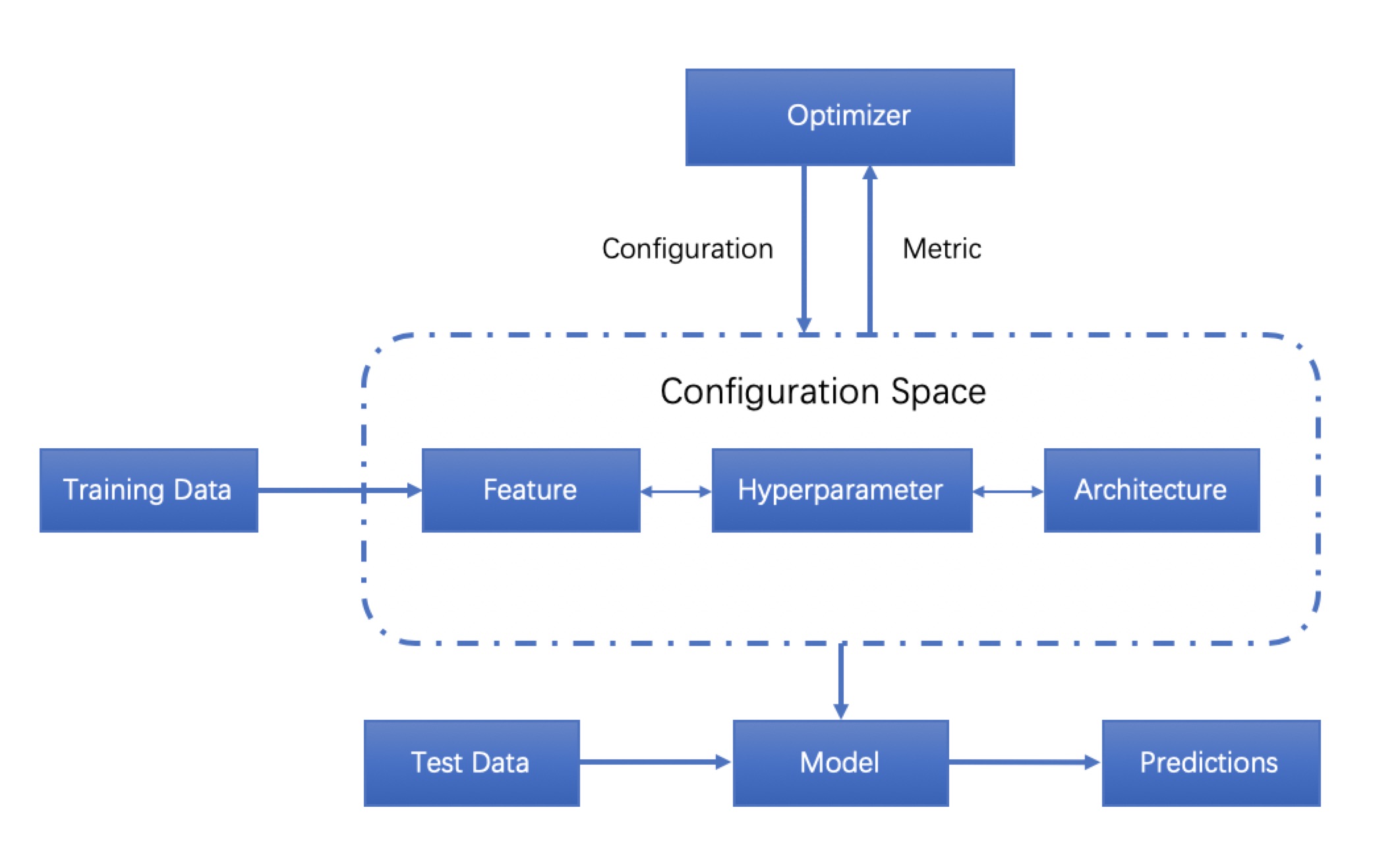
Les approches d’AutoML sont désormais assez mûres pour rivaliser avec les spécialistes du ML, et parfois même les surpasser. En bref, l’AutoML peut améliorer les performances tout en faisant gagner beaucoup de temps et d’argent, car les spécialistes du ML sont rares et coûteux. L’intérêt commercial pour l’AutoML a donc fortement augmenté ces dernières années, et plusieurs grandes entreprises technologiques ainsi que des start-up développent leurs propres systèmes. Le tableau ci-dessous présente une comparaison de quelques-uns d’entre eux.
| Entreprise | AutoFE | HPO | NAS |
|---|---|---|---|
| 4paradigm | √ | √ | × |
| Alibaba | × | √ | × |
| Baidu | × | × | √ |
| Determined AI | × | √ | √ |
| √ | √ | √ | |
| DataCanvas | √ | √ | √ |
| H2O.ai | √ | √ | × |
| Microsoft | × | √ | √ |
| MLJAR | √ | √ | √ |
| RapidMiner | √ | √ | × |
| Tencent | × | √ | × |
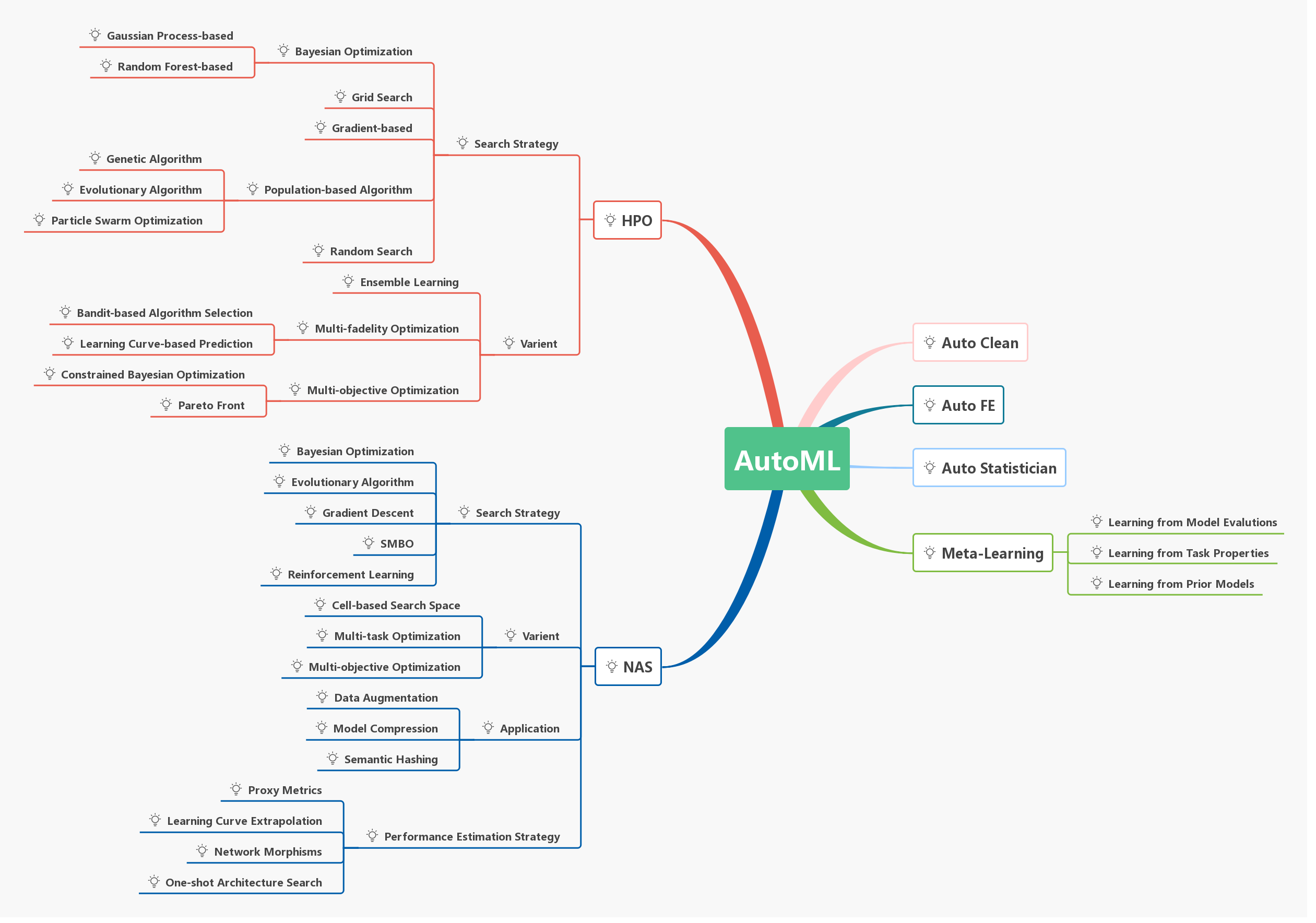
Awesome-AutoML-Papers propose des synthèses récentes des techniques fondamentales de l’AutoML :
- Nettoyage automatisé des données (Auto Clean)
- Ingénierie automatisée des caractéristiques (Auto FE)
- Optimisation des hyperparamètres (HPO)
- Méta-apprentissage
- Recherche d’architecture neuronale (NAS)
Sommaire
Section intitulée « Sommaire »- Articles de recherche
- Tutoriels
- Articles
- Présentations
- Livres
- Projets
- Chercheurs renommés
Articles de recherche
Section intitulée « Articles de recherche »Études de synthèse
Section intitulée « Études de synthèse »- 2019 | AutoML: A Survey of the State-of-the-Art | Xin He, et al. | arXiv |
PDF - 2019 | Survey on Automated Machine Learning | Marc Zoeller, Marco F. Huber | arXiv |
PDF - 2019 | Automated Machine Learning: State-of-The-Art and Open Challenges | Radwa Elshawi, et al. | arXiv |
PDF - 2018 | Taking Human out of Learning Applications: A Survey on Automated Machine Learning | Quanming Yao, et al. | arXiv |
PDF - 2020 | On Hyperparameter Optimization of Machine Learning Algorithms: Theory and Practice | Li Yang, et al. | Neurocomputing |
PDF - 2020 | Automated Machine Learning—a brief review at the end of the early years | Escalante, H. J. | arXiv |
PDF - 2022 | IoT Data Analytics in Dynamic Environments: From An Automated Machine Learning Perspective | Li Yang, et al. | arXiv |
PDF - 2024 | Automated machine learning: past, present and future | Baratchi. M, et al. | Artificial Intelligence Review |
Springer
Ingénierie automatisée des caractéristiques
Section intitulée « Ingénierie automatisée des caractéristiques »-
Expansion et réduction
Section intitulée « Expansion et réduction »
- 2022 | BERT-Sort: A Zero-shot MLM Semantic Encoder on Ordinal Features for AutoML | Mehdi Bahrami, et al. | AutoML |
PDF - 2017 | AutoLearn — Automated Feature Generation and Selection | Ambika Kaul, et al. | ICDM |
PDF - 2017 | One button machine for automating feature engineering in relational databases | Hoang Thanh Lam, et al. | arXiv |
PDF - 2016 | Automating Feature Engineering | Udayan Khurana, et al. | NIPS |
PDF - 2016 | ExploreKit: Automatic Feature Generation and Selection | Gilad Katz, et al. | ICDM |
PDF - 2015 | Deep Feature Synthesis: Towards Automating Data Science Endeavors | James Max Kanter, Kalyan Veeramachaneni | DSAA |
PDF
-
Organisation hiérarchique des transformations
Section intitulée « Organisation hiérarchique des transformations »- 2016 | Cognito: Automated Feature Engineering for Supervised Learning | Udayan Khurana, et al. | ICDMW |
PDF
- 2016 | Cognito: Automated Feature Engineering for Supervised Learning | Udayan Khurana, et al. | ICDMW |
-
Méta-apprentissage
Section intitulée « Méta-apprentissage » -
Apprentissage par renforcement
Section intitulée « Apprentissage par renforcement »
Recherche d’architecture
Section intitulée « Recherche d’architecture »-
Algorithmes évolutionnaires
Section intitulée « Algorithmes évolutionnaires »- 2019 | Evolutionary Neural AutoML for Deep Learning | Jason Liang, et al. | GECCO |
PDF - 2017 | Large-Scale Evolution of Image Classifiers | Esteban Real, et al. | PMLR |
PDF - 2002 | Evolving Neural Networks through Augmenting Topologies | Kenneth O.Stanley, Risto Miikkulainen | Evolutionary Computation |
PDF
- 2019 | Evolutionary Neural AutoML for Deep Learning | Jason Liang, et al. | GECCO |
-
Recherche locale
Section intitulée « Recherche locale »- 2017 | Simple and Efficient Architecture Search for Convolutional Neural Networks | Thomoas Elsken, et al. | ICLR |
PDF
- 2017 | Simple and Efficient Architecture Search for Convolutional Neural Networks | Thomoas Elsken, et al. | ICLR |
-
Méta-apprentissage
Section intitulée « Méta-apprentissage »- 2016 | Learning to Optimize | Ke Li, Jitendra Malik | arXiv |
PDF
- 2016 | Learning to Optimize | Ke Li, Jitendra Malik | arXiv |
-
Apprentissage par renforcement
Section intitulée « Apprentissage par renforcement »- 2018 | AMC: AutoML for Model Compression and Acceleration on Mobile Devices | Yihui He, et al. | ECCV |
PDF - 2018 | Efficient Neural Architecture Search via Parameter Sharing | Hieu Pham, et al. | arXiv |
PDF - 2017 | Neural Architecture Search with Reinforcement Learning | Barret Zoph, Quoc V. Le | ICLR |
PDF
- 2018 | AMC: AutoML for Model Compression and Acceleration on Mobile Devices | Yihui He, et al. | ECCV |
-
Transfert d’apprentissage
Section intitulée « Transfert d’apprentissage »- 2017 | Learning Transferable Architectures for Scalable Image Recognition | Barret Zoph, et al. | arXiv |
PDF
- 2017 | Learning Transferable Architectures for Scalable Image Recognition | Barret Zoph, et al. | arXiv |
-
Morphisme de réseau
Section intitulée « Morphisme de réseau »- 2019 | Auto-Keras: An Efficient Neural Architecture Search System | Haifeng Jin, et al. | KDD |
PDF
- 2019 | Auto-Keras: An Efficient Neural Architecture Search System | Haifeng Jin, et al. | KDD |
-
Optimisation continue
Section intitulée « Optimisation continue »
Cadres logiciels
Section intitulée « Cadres logiciels »- 2019 | Auptimizer — an Extensible, Open-Source Framework for Hyperparameter Tuning | Jiayi Liu, et al. | IEEE Big Data |
PDF - 2019 | Towards modular and programmable architecture search | Renato Negrinho, et al. | NeurIPS |
PDF - 2019 | Evolutionary Neural AutoML for Deep Learning | Jason Liang, et al. | arXiv |
PDF - 2017 | ATM: A Distributed, Collaborative, Scalable System for Automated Machine Learning | T. Swearingen, et al. | IEEE |
PDF - 2017 | Google Vizier: A Service for Black-Box Optimization | Daniel Golovin, et al. | KDD |
PDF - 2015 | AutoCompete: A Framework for Machine Learning Competitions | Abhishek Thakur, et al. | ICML |
PDF
Optimisation des hyperparamètres
Section intitulée « Optimisation des hyperparamètres »-
Optimisation bayésienne
Section intitulée « Optimisation bayésienne »- 2020 | Bayesian Optimization of Risk Measures | NeurIPS |
PDF - 2020 | BOTORCH: A Framework for Efficient Monte-Carlo Bayesian Optimization | NeurIPS |
PDF - 2020 | Tuning Hyperparameters without Grad Students: Scalable and Robust Bayesian Optimisation with Dragonfly | JMLR |
PDF - 2019 | Bayesian Optimization with Unknown Search Space | NeurIPS |
PDF - 2019 | Constrained Bayesian optimization with noisy experiments |
PDF - 2019 | Learning search spaces for Bayesian optimization: Another view of hyperparameter transfer learning | NeurIPS |
PDF - 2019 | Practical Two-Step Lookahead Bayesian Optimization | NeurIPS |
PDF - 2019 | Predictive entropy search for multi-objective bayesian optimization with constraints |
PDF - 2018 | BOCK: Bayesian optimization with cylindrical kernels | ICML |
PDF - 2018 | Efficient High Dimensional Bayesian Optimization with Additivity and Quadrature Fourier Features | Mojmír Mutný, et al. | NeurIPS |
PDF - 2018 | High-Dimensional Bayesian Optimization via Additive Models with Overlapping Groups. | PMLR |
PDF - 2018 | Maximizing acquisition functions for Bayesian optimization | NeurIPS |
PDF - 2018 | Scalable hyperparameter transfer learning | NeurIPS |
PDF - 2016 | Bayesian Optimization with Robust Bayesian Neural Networks | Jost Tobias Springenberg, et al. | NIPS |
PDF - 2016 | Scalable Hyperparameter Optimization with Products of Gaussian Process Experts | Nicolas Schilling, et al. | PKDD |
PDF - 2016 | Taking the Human Out of the Loop: A Review of Bayesian Optimization | Bobak Shahriari, et al. | IEEE |
PDF - 2016 | Towards Automatically-Tuned Neural Networks | Hector Mendoza, et al. | JMLR |
PDF - 2016 | Two-Stage Transfer Surrogate Model for Automatic Hyperparameter Optimization | Martin Wistuba, et al. | PKDD |
PDF - 2015 | Efficient and Robust Automated Machine Learning |
PDF - 2015 | Hyperparameter Optimization with Factorized Multilayer Perceptrons | Nicolas Schilling, et al. | PKDD |
PDF - 2015 | Hyperparameter Search Space Pruning - A New Component for Sequential Model-Based Hyperparameter Optimization | Martin Wistua, et al. |
PDF - 2015 | Joint Model Choice and Hyperparameter Optimization with Factorized Multilayer Perceptrons | Nicolas Schilling, et al. | ICTAI |
PDF - 2015 | Learning Hyperparameter Optimization Initializations | Martin Wistuba, et al. | DSAA |
PDF - 2015 | Scalable Bayesian optimization using deep neural networks | Jasper Snoek, et al. | ACM |
PDF - 2015 | Sequential Model-free Hyperparameter Tuning | Martin Wistuba, et al. | ICDM |
PDF - 2013 | Auto-WEKA: Combined Selection and Hyperparameter Optimization of Classification Algorithms |
PDF - 2013 | Making a Science of Model Search: Hyperparameter Optimization in Hundreds of Dimensions for Vision Architectures | J. Bergstra | JMLR |
PDF - 2012 | Practical Bayesian Optimization of Machine Learning Algorithms |
PDF - 2011 | Sequential Model-Based Optimization for General Algorithm Configuration(extended version) |
PDF
- 2020 | Bayesian Optimization of Risk Measures | NeurIPS |
-
Algorithmes évolutionnaires
Section intitulée « Algorithmes évolutionnaires »- 2020 | Delta-STN: Efficient Bilevel Optimization for Neural Networks using Structured Response Jacobians | Juhan Bae, Roger Grosse | Neurips |
PDF - 2018 | Autostacker: A Compositional Evolutionary Learning System | Boyuan Chen, et al. | arXiv |
PDF - 2017 | Large-Scale Evolution of Image Classifiers | Esteban Real, et al. | PMLR |
PDF - 2016 | Automating biomedical data science through tree-based pipeline optimization | Randal S. Olson, et al. | ECAL |
PDF - 2016 | Evaluation of a tree-based pipeline optimization tool for automating data science | Randal S. Olson, et al. | GECCO |
PDF
- 2020 | Delta-STN: Efficient Bilevel Optimization for Neural Networks using Structured Response Jacobians | Juhan Bae, Roger Grosse | Neurips |
-
Lipschitz Functions
Section intitulée « Lipschitz Functions »- 2017 | Global Optimization of Lipschitz functions | C´edric Malherbe, Nicolas Vayatis | arXiv |
PDF
- 2017 | Global Optimization of Lipschitz functions | C´edric Malherbe, Nicolas Vayatis | arXiv |
-
Recherche locale
Section intitulée « Recherche locale »- 2009 | ParamILS: An Automatic Algorithm Configuration Framework | Frank Hutter, et al. | JAIR |
PDF
- 2009 | ParamILS: An Automatic Algorithm Configuration Framework | Frank Hutter, et al. | JAIR |
-
Méta-apprentissage
Section intitulée « Méta-apprentissage »- 2019 | OBOE: Collaborative Filtering for AutoML Model Selection | Chengrun Yang, et al. | KDD |
PDF - 2019 | SMARTML: A Meta Learning-Based Framework for Automated Selection and Hyperparameter Tuning for Machine Learning Algorithms |
PDF - 2008 | Cross-Disciplinary Perspectives on Meta-Learning for Algorithm Selection |
PDF
- 2019 | OBOE: Collaborative Filtering for AutoML Model Selection | Chengrun Yang, et al. | KDD |
-
Optimisation par essaim particulaire
Section intitulée « Optimisation par essaim particulaire »- 2017 | Particle Swarm Optimization for Hyper-parameter Selection in Deep Neural Networks | Pablo Ribalta Lorenzo, et al. | GECCO |
PDF - 2008 | Particle Swarm Optimization for Parameter Determination and Feature Selection of Support Vector Machines | Shih-Wei Lin, et al. | Expert Systems with Applications |
PDF
- 2017 | Particle Swarm Optimization for Hyper-parameter Selection in Deep Neural Networks | Pablo Ribalta Lorenzo, et al. | GECCO |
-
Recherche aléatoire
Section intitulée « Recherche aléatoire » -
Transfert d’apprentissage
Section intitulée « Transfert d’apprentissage »- 2016 | Efficient Transfer Learning Method for Automatic Hyperparameter Tuning | Dani Yogatama, Gideon Mann | JMLR |
PDF - 2016 | Flexible Transfer Learning Framework for Bayesian Optimisation | Tinu Theckel Joy, et al. | PAKDD |
PDF - 2016 | Hyperparameter Optimization Machines | Martin Wistuba, et al. | DSAA |
PDF - 2013 | Collaborative Hyperparameter Tuning | R´emi Bardenet, et al. | ICML |
PDF
- 2016 | Efficient Transfer Learning Method for Automatic Hyperparameter Tuning | Dani Yogatama, Gideon Mann | JMLR |
- 2020 | Automated Machine Learning Techniques for Data Streams | Alexandru-Ionut Imbrea |
PDF - 2018 | Accelerating Neural Architecture Search using Performance Prediction | Bowen Baker, et al. | ICLR |
PDF - 2017 | Automatic Frankensteining: Creating Complex Ensembles Autonomously | Martin Wistuba, et al. | SIAM |
PDF - 2018 | Characterizing classification datasets: A study of meta-features for meta-learning | Rivolli, Adriano, et al. | arXiv |
PDF - 2020 | Putting the Human Back in the AutoML Loop | Xanthopoulos, Iordanis, et al. | EDBT/ICDT |
PDF
Tutoriels
Section intitulée « Tutoriels »Optimisation bayésienne
Section intitulée « Optimisation bayésienne »- 2018 | A Tutorial on Bayesian Optimization. |
PDF - 2010 | A Tutorial on Bayesian Optimization of Expensive Cost Functions, with Application to Active User Modeling and Hierarchical Reinforcement Learning |
PDF
Méta-apprentissage
Section intitulée « Méta-apprentissage »- 2008 | Metalearning - A Tutorial |
PDF
| Type | Titre du blog | Lien |
|---|---|---|
| HPO | Bayesian Optimization for Hyperparameter Tuning | Link |
| Meta-Learning | Learning to learn | Link |
| Meta-Learning | Why Meta-learning is Crucial for Further Advances of Artificial Intelligence? | Link |
| Année de publication | Type | Titre du livre | Auteurs | Éditeur | Lien |
|---|---|---|---|---|---|
| 2009 | Meta-Learning | Metalearning - Applications to Data Mining | Brazdil, P., Giraud Carrier, C., Soares, C., Vilalta, R. | Springer | Download |
| 2019 | HPO, Meta-Learning, NAS | AutoML: Methods, Systems, Challenges | Frank Hutter, Lars Kotthoff, Joaquin Vanschoren | Download | |
| 2021 | Learning | Automated Machine Learning in Action | Qinquan Song, Haifeng Jin, Xia Hu | Manning Publications | Download |
| Titre | Auteur | Lien | | AutoML Basics: Automated Machine Learning in Action | Qinquan Song, Haifeng Jin, Xia Hu | (https://www.youtube.com/watch?v=9KpieG0B7VM) |
| Projet | Type | Langue | Licence | Lien |
|---|---|---|---|---|
| AdaNet | NAS | Python | Apache-2.0 | Github |
| Advisor | HPO | Python | Apache-2.0 | Github |
| AMLA | HPO, NAS | Python | Apache-2.0 | Github |
| ATM | HPO | Python | MIT | Github |
| Auger | HPO | Python | Commercial | Homepage |
| auptimizer | HPO, NAS | Python (support R script) | GPL-3.0 | Github |
| Auto-Keras | NAS | Python | License | Github |
| AutoML Vision | NAS | Python | Commercial | Homepage |
| AutoML Video Intelligence | NAS | Python | Commercial | Homepage |
| AutoML Natural Language | NAS | Python | Commercial | Homepage |
| AutoML Translation | NAS | Python | Commercial | Homepage |
| AutoML Tables | AutoFE, HPO | Python | Commercial | Homepage |
| AutoPyTorch | HPO, NAS | Python | Apache-2.0 | Github |
| HyperGBM | HPO | Python | Python | Github |
| HyperKeras | NAS | Python | Python | Github |
| Hypernets | HPO, NAS | Python | Python | Github |
| auto-sklearn | HPO | Python | License | Github |
| auto_ml | HPO | Python | MIT | Github |
| BayesianOptimization | HPO | Python | MIT | Github |
| BayesOpt | HPO | C++ | AGPL-3.0 | Github |
| comet | HPO | Python | Commercial | Homepage |
| DataRobot | HPO | Python | Commercial | Homepage |
| DEvol | NAS | Python | MIT | Github |
| DeepArchitect | NAS | Python | MIT | Github |
| Determined | HPO, NAS | Python | Apache-2.0 | Github |
| Driverless AI | AutoFE | Python | Commercial | Homepage |
| FAR-HO | HPO | Python | MIT | Github |
| H2O AutoML | HPO | Python, R, Java, Scala | Apache-2.0 | Github |
| HpBandSter | HPO | Python | BSD-3-Clause | Github |
| HyperBand | HPO | Python | License | Github |
| Hyperopt | HPO | Python | License | Github |
| Hyperopt-sklearn | HPO | Python | License | Github |
| Hyperparameter Hunter | HPO | Python | MIT | Github |
| Katib | HPO | Python | Apache-2.0 | Github |
| MateLabs | HPO | Python | Commercial | Github |
| Milano | HPO | Python | Apache-2.0 | Github |
| MLJAR | AutoFE, HPO, NAS | Python | MIT | Github |
| mlr3automl | HPO | R | LGPL-3.0 | GitHub |
| nasbot | NAS | Python | MIT | Github |
| neptune | HPO | Python | Commercial | Homepage |
| NNI | HPO, NAS | Python | MIT | Github |
| Oboe | HPO | Python | BSD-3-Clause | Github |
| Optunity | HPO | Python | License | Github |
| R2.ai | HPO | Commercial | Homepage | |
| RBFOpt | HPO | Python | License | Github |
| RoBO | HPO | Python | BSD-3-Clause | Github |
| Scikit-Optimize | HPO | Python | License | Github |
| SigOpt | HPO | Python | Commercial | Homepage |
| SMAC3 | HPO | Python | License | Github |
| TPOT | AutoFE, HPO | Python | LGPL-3.0 | Github |
| TransmogrifAI | HPO | Scala | BSD-3-Clause | Github |
| Tune | HPO | Python | Apache-2.0 | Github |
| Xcessiv | HPO | Python | Apache-2.0 | Github |
| SmartML | HPO | R | GPL-3.0 | Github |
| MLBox | AutoFE, HPO | Python | BSD-3 License | Github |
| AutoAI Watson | AutoFE, HPO | Commercial | Homepage | |
| AUtoML | AutoML | Python | MIT | Github |
| Optuna | HPO | Python | MIT | Github |
Présentations
Section intitulée « Présentations »| Type | Titre de la présentation | Auteurs | Lien |
|---|---|---|---|
| AutoFE | Automated Feature Engineering for Predictive Modeling | Udyan Khurana, etc al. | Download |
| HPO | A Tutorial on Bayesian Optimization for Machine Learning | Ryan P. Adams | Download |
| HPO | Bayesian Optimisation | Gilles Louppe | Download |
Remerciements
Section intitulée « Remerciements »Un grand merci à toutes les personnes qui ont contribué à ce projet.
| Nom | Biographie |
|---|---|
| Alexander Robles | Doctorant à l’UNICAMP (Brésil) |
| derekflint | |
| endymecy | Chercheur senior chez Tencent |
| Eric | |
| Erin LeDell | Scientifique en chef du machine learning chez H2O.ai |
| fwcore | |
| Gaurav Mittal | |
| Hernan Ceferino Vazquez | Docteur, expert en science des données chez MercadoLibre |
| Kaustubh Damania | |
| Lilian Besson | Doctorant à CentraleSupélec |
| 罗磊 | |
| Marc | |
| Mohamed Maher | |
| Neil Conway | Directeur technique chez Determined AI |
| Richard Liaw | Doctorant à l’UC Berkeley |
| Randy Olson | Responsable de la science des données chez LifeEGX |
| Slava Kurilyak | Fondateur et PDG de Produvia |
| Saket Maheshwary | Chercheur en IA |
| shaido987 | |
| sophia-wright-blue | |
| tengben0905 | |
| xuehui | @Microsoft |
| Yihui He | Étudiant diplômé à Carnegie Mellon |
Contact et commentaires
Section intitulée « Contact et commentaires »Si vous avez des suggestions (articles manquants ou nouveaux, chercheurs importants ou coquilles), n’hésitez pas à soumettre une demande. Vous pouvez également écrire à :
- Mark Lin (hibayesian@gmail.com).
Licences
Section intitulée « Licences »Awesome-AutoML-Papers est distribué sous licence Apache 2.0.
HagiCode
HagiCode est un espace de développement agentique. Des interactions d’interface riches et pratiques rendent la planification, l’exécution des agents et le travail sur les projets accessibles et faciles à suivre, pour une expérience de développement engageante.
Une expérience de développement engageante grâce à des interactions d’interface riches et pratiques.

- IntelligentLes workflows OpenSpec transforment une intention en parcours exécutable, de la proposition à la livraison en passant par la conception et les tâches.
- EfficaceL’exécution multi-agent fait avancer recherche, réalisation et revue en parallèle, sur plusieurs dépôts et avec les Agent CLI que vous utilisez déjà.
- IntéressantDes interactions d’interface riches et pratiques rendent la planification, l’exécution des agents et le travail sur les projets accessibles et faciles à suivre.
Télécharger pour Windows
Partager HagiCode

Transformez vos idées en logiciels livrés.
HagiCode est un espace de développement agentique : les workflows OpenSpec planifient le changement, l’exécution multi-agent le réalise et Hero Scenario rend le long parcours visible, pour transformer vos idées en logiciels livrés.
- Intelligent
- Les workflows OpenSpec transforment une intention en parcours, de la proposition à la livraison.
- Efficace
- L’exécution multi-agent mène recherche, réalisation et revue en parallèle.
- Ludique
- Les interactions d’interface facilitent la planification, l’exécution des agents et les projets.
© 2026 HagiCode | Powered By hagilight-starlight@0.21.0 | Branch: main | Commit: 745b50b | Built: